Wednesday, August 27, 2014

08-27-2014 Jade City

Post 08-27-2014 Jade City, Yukon, Canada

Leaving Watson Lake, we got an early start and  headed South on Highway 37, Cassier Highway,  toward Stewart, BC  and Hyder, AK. Signs says 420 miles.  A long haul for one day but we did it plus we stopped in Jade City for about an hour and a half.  The first part of the highway was rough, lots of gravel and dirt, potholes and narrow curves etc. (Also very isolated, hardly any traffic, mailboxes, driveways, etc).  BUT, the last 150-200 miles, through the Coastal Mountains was as beautiful as any drive anywhere in Alaska with  glaciers, waterfalls, wild mountain streams and the rainforest, so lush and green. Yep, rainforest. Alaska,  the Yukon and BC are full of them.

Jade City

In the middle of nowhere, about 119 miles from Upper Liard over a rough highway that was just full of tundra heaps and potholes and one I won’t ever drive over again we reached Jade City.

Jade City is a Jade stone mining town of about 85 people. Two of the three businesses are owned by the same Lady. One is a  retail store  that sells virtually anything made of Jade you could want. Prices run from less than $1.00 to over $20,000. The owner exports 90% of mined Jade ore to China and she owns a Jade design and manufacturing company there as well. This store will also  cut jade rock you purchase from them  and help you polish them.


                                 Kylee Ryan

                            Jade Ore


                  basin Washbowl


                            Raw uncut Jade

                                They will cut it for you


                Stone cutter


                          Everyone signs the board

 Her other business is a First Nation Native Art Gallery and retail store that has everything imaginable on display and for sale. Everything is authentic native art. They had a few Jade pirate type ships on display and for sale, price tag of $65,000 on them and a couple others for a measly $35,000. I was going to buy one but my credit card was a little snippy and wouldn’t approve it (LOL). I’ve never seen so much beautiful and authentic First Nation Art.

                             This one is $65,000

                               This one is $35,000

On sale for $4,000


I had a conversation with the wonderful  young girl who worked there as well as across the street at the Jade Store, Kylee Ryan, was only 19 and was of First Nation Heritage. She told me some of the history of the place, i.e. where the art pieces were made and about the owner. She is hoping to get more involved with the operation of the business as time goes by. I wished her all the good fortune in the world.

                              Kylee Ryan
The only other business there is a restaurant where we had a delicious breakfast (me) and lunch (Nita). Nita had a BLT made with Canadian Bacon  on  restaurant baked bread  and a  bowl of restaurant made Salmon Vegetable Soup that was absolutely scrumptious. We bought a quart to take with us and Nita met the cook and got his recipe for it. We’ll have some tomorrow. The cook, Andy, (loves to bake bread and make soup) is from Montreal but had lived in small towns from the age of 7 until he returned to Montreal to attend college.  He can probably get a position in any restaurant he chooses, he’s that good, however, the owner as assured him that she wants him back next year when they start up again (usually May). He indicated he loved it there and will happily come back and maybe even to live at least in the summer-like everyone else.  And, Andy, the soup was wonderful as we traveled down the road.

                                 
                                          local having breakfast

                                    Andy

                    A Jade table--see the rectangles of Jade. There were about 10 tables in the restaurant

The rest of the drive to Stewart and Hyder was much smoother and we made better time.  The weather was rainy in some areas but just mostly a misty drizzle.  By the time we got to Hyder it cleared up and was gorgeous. We saw some beautiful glaciers along the way and a black  bear walking along the roadway. He was just ambling along eating some of the plants and berries. The 30 miles from Meziadin Junction is about as gorgeous as it can get.

In Hyder, we stayed at the Run-a-Muck RV Park, the only one in town and the closest to the bear platform and the Salmon  Glacier. We’ll tell you about those in the next posting.


Helo stringing wire


Just another gorgeous glacier


A church in the wilderness                                 Narrow one lane bridge


Ciao!,  until we meet again.


Post 08-26/27 2014 Nisutlin Bay Bridge and Teslin

Post 08-26/27 2014  Nisutlin  Bay Bridge and Teslin

We got away from Whitehorse around 10:30 and drove to Teslin, Yukon and stopped for a visit with the George Johnson  Museum and the Teslin Tlingit Heritage Museum. Both were excellent exhibits of their own and I’ll try to explain them to you.

George Johnson Museum.

George Johnson was a Tlingit Indian who became one of the area’s most prominent citizens. He opened a general store and was a very good businessman.  Being an uneducated native he had to struggle with life in general and even more so to accomplish his mission.

George became a photographer of his people and the area, and he was able to capture them as they wanted and not unknowingly like we do today so often. His pictures documented his and his people’s way of life. Using a small camera purchased from a catalogue for $7.99 (about 1920) from a company very similar to Sears Roebuck, he also learned how to develop his film to realize almost instant pictures and prided himself that he didn’t have to wait while the film was developed in Whitehorse. It would have taken weeks because of the distance to get there.

His one other noted accomplishment was the purchase of a 1926 Chevrolet four door at a time when he not only did not know how to drive, -the company that sold it to him taught him before he took it back to Teslin,-there were no roads in Teslin to drive it on.  In order to get it back to Teslin from Whitehorse aboard the Steamer S.S.  Keno they had to cut a larger opening in the side of the ship to get it in. Must have been quite a struggle and to get the captain of the boat to cut a larger opening.

Since Teslin did not have any roads,  George  and his pals cut a swath of  road through the trees of  a couple of blocks and later extended it about three kilometers. He started a taxi service of sorts and charged customers $2.00 per ride.  He then used the money to pay his friends to lengthen the road. When Winter came  he discovered  he could drive it on the Teslin Lake after  it froze over thus giving him an 86 mile highway.  Gas being scarce, he used Naphtha (like alcohol) bought at the local drug and hardware store. Naphtha was the original fuel for automobiles before gas. The motor would run on either. ( NASCAR used to use a lot of it to bolster the power of the race car). When WWII  started and the  Army showed up to build the ALCAN (Alaska) Highway, they bought  his highway and made it a part of the ALCAN.  Rebuilt it of course. But then again it gave George more highway to drive on.

He also used  the car for hunting. But it’s black color startled the game so he painted it white with house paint in the winter and back to black in the summer

After the war he became disenchanted and at odds with the government because of the way the Tlingit’s were treated. Like the American Indians, the U.S. and Canadian governments  royally screwed them over by taking their land and homes, relocating them several times and refused to recognize them. Of note, there were no diseases before the road and many of them died  from measles, mumps‘, and  pneumonia because the U.S. Army refused to treat them and they had the only doctors available. The nearest (and only one Dr. at that time ) was in  Whitehorse, 120 miles away.

After many, many years of fighting the government, they finally gained their independence (all eleven tribes) and the right to self govern from the Canadian government. Today, they are also an integral part of the Canadian Government as well as governing themselves.

George had traded his car for a truck in Whitehorse and later after he died, the car company restored it, gave it to the Canadian government who now allows his museum in Teslin to display it. They had a difficult time trying to determine the original color because of the many coats of paint that had been applied by George.

We were able to watch a movie that chronicled his life that was very interesting. I love watching that type of movies.  I know I missed a lot but it’s OK, I’m getting older.


Elk Hide

Beaver

Hawk

Marmot

Fish catcher


Side of Cabin


1926 Chevrolet


Sealskin blanket


Lynx Paw Blanket


Dress Regala


Tlingit Heritage Center.

The center was built by the Tlingit’s as a place to exhibit their artistic abilities to the general public and as a training/school facility to teach the children their heritage. We watched a movie on the Indian history of the year there were two winters.  A volcano eruption in Thailand created a great black cloud that shut out the sun for the summer months.  The animals left, the people suffered the cold and hunger and many died.

While there we were allowed to snack on  a bread called “Bannon”. It is a bread that is fried similar to cake donuts.  MAN! Was it ever delicious. Nita and I each  had three of them. I put butter, peanut butter and preserves on mine and “pigged out” Nita has the recipe and plans on making some in the near future (tomorrow maybe, ha!) Sorry, no photo.

We have spent many hours in the “Indian” facilities.  Their history is so interesting and similar to the Aboriginals of Australia.  They had no written language but their culture has been handed down in their stories, songs, dances and artwork.  They have lived in a harsh land for several thousand years and have amazing knowledge of the land, plants and animals.  In many ways the modern world has changed their lifestyle but for the most part they are realizing the value of their heritage.


Tribal council office


building a log cabin

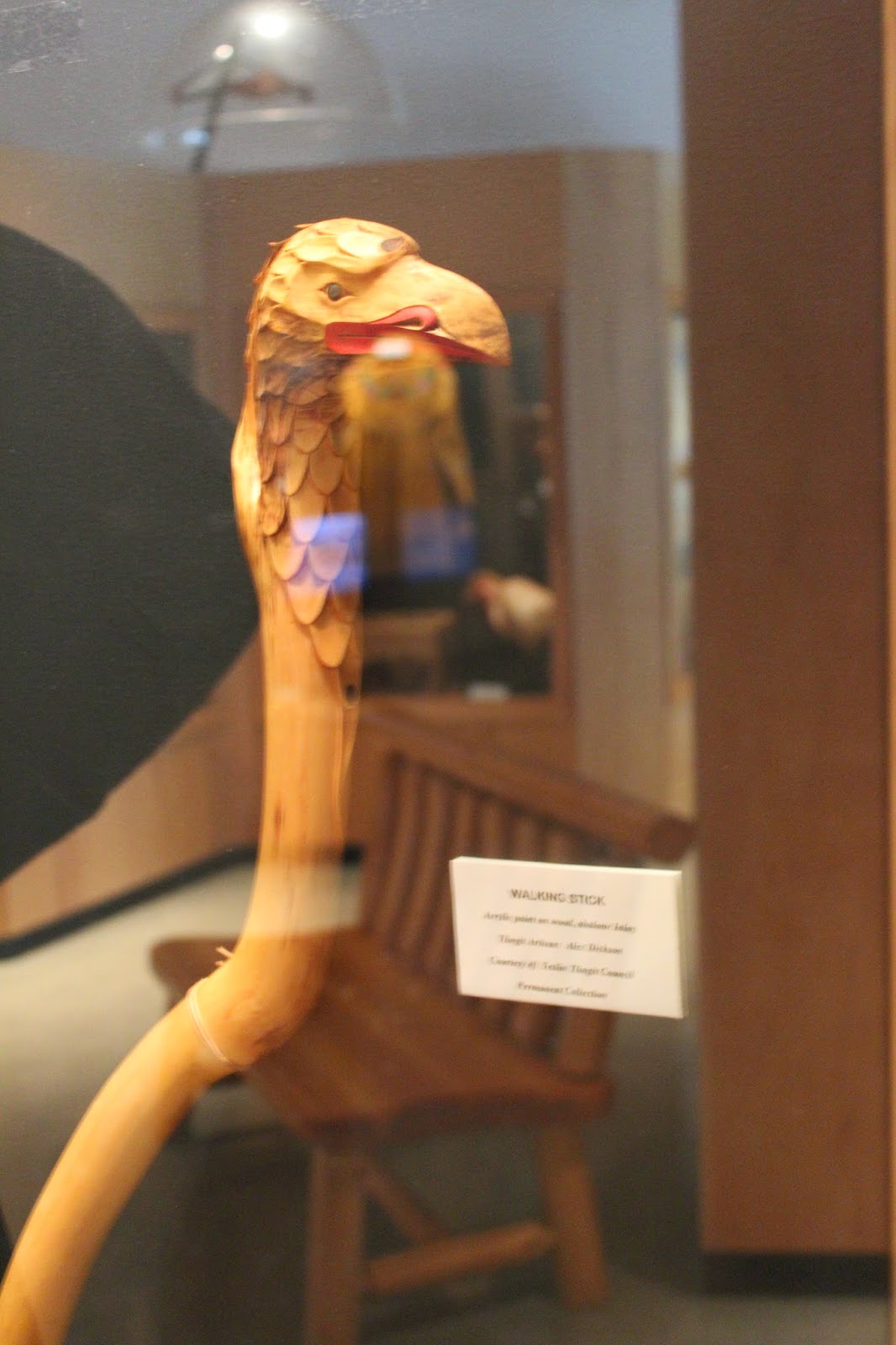
Eagle sculpture


papoose carrier

Ceremonial Vest

Two saddles


Moving along we crossed river the Nisutlin Bay Bridge. It is the longest water span on the Alaska Highway. Nisutlin River forms the “Bay” as it flows into Teslin Lake which as I mentioned is 86 miles long, averages two miles wide and is the longest in the Yukon. The Tlingit name for it is “Teslintoo”( long  narrow water).

For tonight we are in the Big Creek Bridge Yukon Government Campground  between Upper Liard and  Watson Lake, Yukon  since they don’t allow us to park along the highway like Alaska does. It’s full but we were able to park along one of the roads without blocking traffic. A rule said we must park in a authorized campsite but we ignored it.  Just too late to look for another campground and hope they have a space available.